

Two identically named cities, 2,857 miles apart, one East Coast, the other West Coast. One day in August, husband and I spent time in both, traveling from Richmond, VA, to Richmond, CA, and ultimately hanging my swim cap in Berkeley. The trip took less than 12 hours and would have been faster if we hadn’t hiked at the Golden Gate Bridge and at Muir Woods. (We can’t resist National Parks!)
Why dally in Cali’s Richmond when an elegant pool and soft bed awaited us at Julia Morgan’s legendary Berkeley City Club?
For another historic pool, of course!
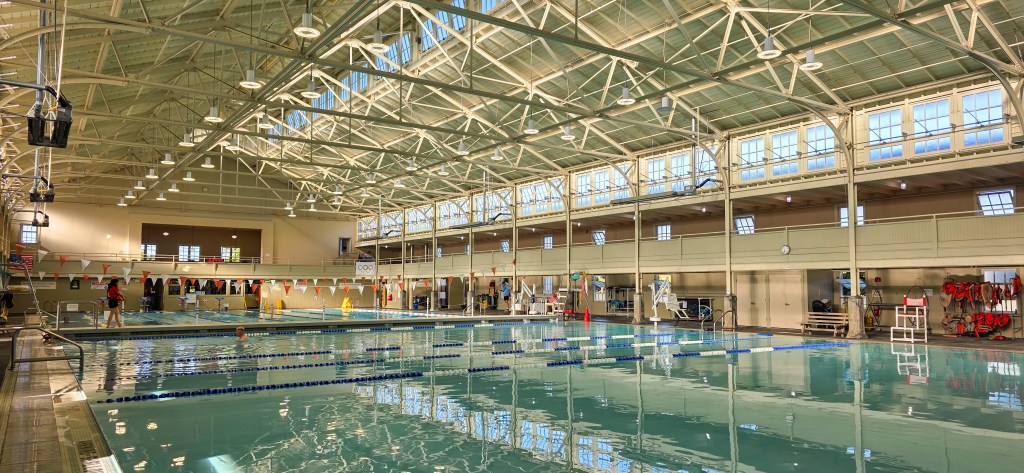

Two years ago, when preparing to launch this blog, I Googled historic pools in Richmond, as Virginia’s state capital is only an hour from my home. At the top of the results was the now 99-year-old beautifully restored Richmond Plunge! Excitedly, I clicked the link… and discovered that my hoped-for blog entry was California dreaming. So I filed the Plunge (as locals call it) along with the Olympic Club and the Berkeley City Club, all waiting for a San Francisco swim-cation opportunity, which happened this summer!
This historic municipal pool is an example of survival despite years of neglect, and a lesson for preservationists and local officials to unify, seek resources and support, and to refuse to throw in the towel.
First of all, how did the Plunge – a large aquatic facility – come to exist in what was then a small city of 20,000 people? Oil! The saying “Truth is stranger than fiction” certainly fits here. In the 1920s, an aspiring oil businessman, John Nicholl, drilled for oil on his property. But he hit another resource instead: Water. Unable to reach his goal, he donated his land and water for city use, and the city of Richmond built and opened The Plunge in 1926.
The Art Deco design and open ceiling trusses reflect aspects of San Francisco’s now-demolished Sutro Baths, a massive 1.7 million gallon facility that could accommodate 10,000 swimmers.
FIN FACT:
The Sutro Baths opened in 1894 on San Francisco’s Pacific shoreline as the largest indoor pool complex in the world. The millionaire builder, Adolph Sutro, had imagined a facility where San Franciscans could bathe and swim in healthy conditions for an affordable price, and he added museum exhibits as educational opportunities, so it’s easy to see how trips to the Baths became an all-day affair for many patrons. They could peruse natural history displays, ancient artifacts and even admire Egyptian mummies! Then they’d rent swimsuits and towels and choose from seven large pools heated to different temperatures!
Sutro was a true visionary. However, he died in 1898, only four years after the opening, and attendance dropped for various reasons (the Depression, improved health codes, and decreased public transit). The owners tried various permutations, like conversion to an ice rink, to make the Baths profitable again. However, in 1964, developers started demolition of the historic building, hoping to build high rise apartments. A fire destroyed the rest of it in 1966.
You can visit the Sutro Baths ruins, which are part of the Golden Gate National Recreation Area.
For more than 50 years, the Plunge provided aquatic fitness and fun for city residents. Then, as the aging hollow-clay wall bricks developed cracks, the city did not complete necessary maintenance, and the building continued to fall into disrepair.
But pool proponents took action, forming the non-profit Richmond Friends of Recreation in 1979, successfully lobbying for equipment replacement and fresh paint throughout the facility.
Unfortunately the pool’s travails continued, with the 1989 Loma Prieta earthquake throwing another damaging punch. Moreover, city voters voted against a measure intended to fix and retrofit the structure, which would make it more earthquake-resistant.

Plunge exterior before renovations and restorations: Kearns, J. (2007). Richmond California Municipal Natatorium (The Plunge) in Point Richmond. Wikimedia Commons. Retrieved from https://commons.wikimedia.org/wiki/File:Richmond_Municipal_Natatorium.JPG. Public domain.
In 1997, facing what seemed to be insurmountable repairs and expenses, the city decided to close the Plunge permanently. However, until 2001, swimmers continued to use the dilapidated facility even though it had been deemed unsafe for use. “Swim at your own risk” truly ruled those years!
Then, when the city shuttered the pool and slated it for imminent demolition, the Richmond Friends of Recreation leaped into the stormy waters. Together, the RFR and the city built a “life boat”– a public/private partnership aimed at seismic retrofits, restorations, and renovations, and ultimately re-opening the Plunge. To fund the $7 million project, they established a “Save the Richmond Plunge Trust.” Donations flowed in from across the economic spectrum, from local residents, businesses, and a t-shirt sale to endowments, grants, and Chevron. A Richmond architect, Todd Jersey, gave hundreds of hours to complete the upgrades, fixes, and environmental improvements, and the renewed Plunge reopened in 2010!


Left image: Richfife. (2009a). Richmond Plunge Exterior. Wikimedia Commons. Retrieved from https://commons.wikimedia.org/wiki/File:RichmondPlunge_Exterior.JPG. Public domain.
Right image: Richfife. (2009b). Richmond Plunge Pool. Wikimedia Commons. Retrieved from https://upload.wikimedia.org/wikipedia/commons/5/5e/RichmondPlunge_Pool.JPG. Public domain.
Today, Plunge staff members and city engineers continue to manage repairs and upkeep of their historic pool, a challenging but rewarding task. John Schonder, head coach of the Richmond Sailfish Swim Team and ardent Plunge supporter, described the teamwork involved and gratitude he feels for the Plunge:
“Their lifeguards will greet you with a smile and the City engineers and facility maintenance personnel do an excellent job with pool chemistry and facilities upkeep. We are so lucky to have this historic pool and I feel fortunate that I get to work there everyday and be a part of the Plunge’s history and legacy.”
His words exactly reflect my experience at the Plunge, which had just reopened after weeks of pump repairs.


I love these tiled locker room signs. The one on the right is for the men.
Upon arrival, I introduced myself at the front desk. The staff members were interested in my blog, and ready to answer questions about their beloved city pool that barely escaped destruction. They clearly care! So do the patrons who shared their involvement. One woman told me how her parents, aunts, siblings, and children had learned to swim here. A man in one of the lap lanes said he works out here three to four times a week because of the history and the beauty.

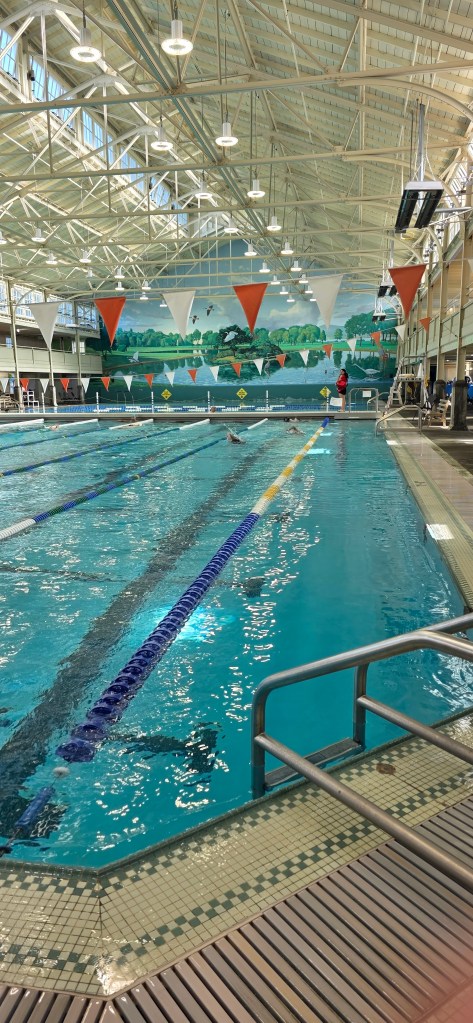
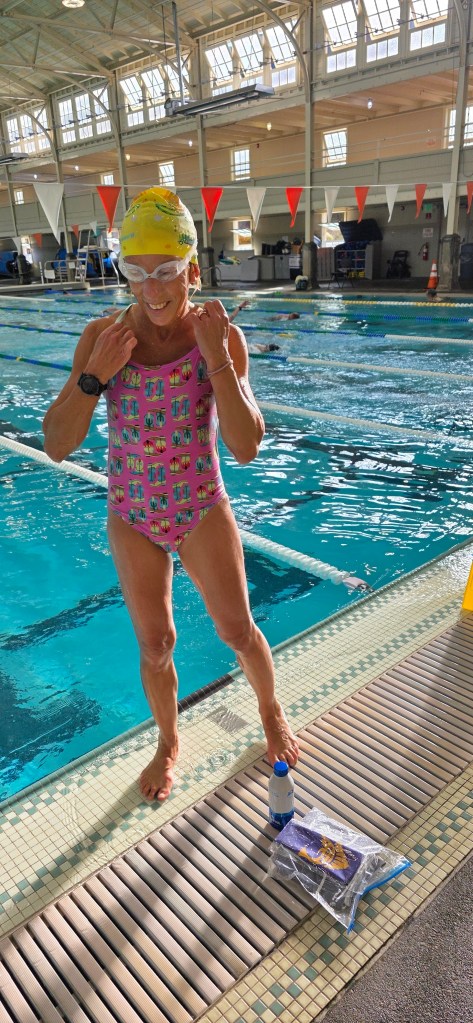
Swim team kids chattered happily as they wrapped up practice, and masters swimmers hopped in to start theirs. As Coach Schonder said, “there’s something here for everyone,” from year-round youth and masters teams to Aqua Zumba and kayak classes!
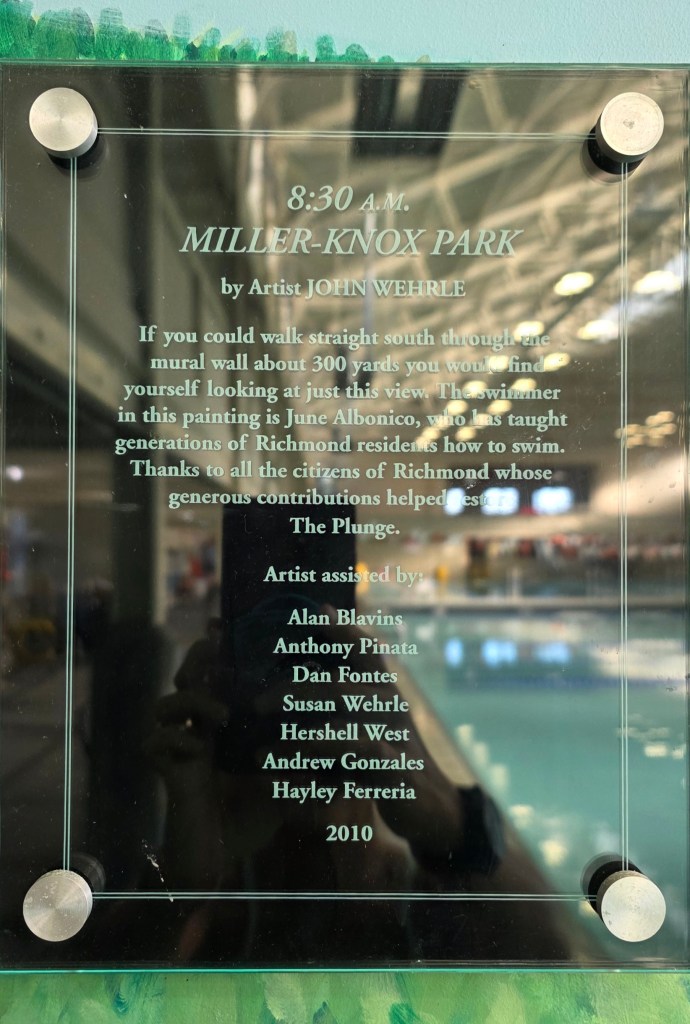
Stepping from the locker room onto the pool deck, I was struck by the bright, natural lighting from windows spanning the length of the facility, which includes a 7-lane, 25-yard section for lap swimming and team practices separated by a bulkhead from a shallower area with 20-yard lanes across the width. Gracing the wall of the far end is a huge pastoral mural of the nearby Miller-Knox Regional Shoreline Park.

FIN FACT:
Artist John Wehrle, a local resident, began his career as a Vietnam combat artist and has since painted many California murals, including those of the 1984 Los Angeles Olympics.
On the far right of this mural, a swimmer surveys the scene. The mirrored plaque below explains that this woman — June Albonico — “taught generations of Richmond residents how to swim.”
The photo below features Ralph Harold Kendrick, another important figure in the history of the Plunge. The caption reads:
“Ralph H Kendrick, born in 1896, was the first, and longest-serving, lifeguard at the Richmond Municipal Natatorium. His tenure there lasted 29 years, from opening day, March 16, 1926, until 1955, after which he finished his 35 years of employment with the City of Richmond’s Civil Engineering Department. He came to the lifeguard job by chance: in 1926, while visiting his brother in Richmond, his car was stolen. Finding himself stranded just as the Plunge was about to have its Grand Opening, hte former Oakland A.A.U competitive swimmer, professional featherweight boxer, avid archer, and WWI veteran had the perfect qualifications–he asked for the lifeguard job, and got it. Over the years, Kendrick saved many lives and never lost one. A Richmond Independent interview once described him as, ‘One of the most colorful old-timers in Richmond.’”

The water temperature, a comfortable 82F, let me slice through a quick 2000 yards while not freezing less active patrons out of the pool, and the saline/chlorine combination soothed my dry-from-flying skin.
As I swam, my husband ran through the park depicted on the mural and then chatted with Coach Schonder, who gave me a Richmond swim team cap! Go Sailfish!
The whole experience was such a treat! If you’re in the Bay area, I highly recommend checking out the Richmond Plunge. It’s lovely, and the staff is terrific!

POOL STATS:
Year completed: 1926
Year reopened after renovations and restorations: 2010
Length: 25 yards (7 lanes), 20 yards (across shallow end)
Depth: 2 feet three inches to 7 feet
Water treatment: Saline-chlorine combination
Temperature: 82F/27.8C
Lockers: Available, but bring your own lock
Entry fee: $8.75 for non-residents, $7 for residents. Kids are cheaper.
Location:
Richmond Plunge
1 East Richmond Avenue
Richmond, CA 94804
510-620-6820
https://www.ci.richmond.ca.us/2140/Richmond-Plunge
For swim team information (age group and masters):
https://richmondswims.org/
References:
Jones, C. (2009, March 14). Beloved Richmond Pool’s comeback making Splash. SFGate. https://www.sfgate.com/bayarea/article/beloved-richmond-pool-s-comeback-making-splash-3248209.php
Kearns, J. (2007). Richmond California Municipal Natatorium (The Plunge) in Point Richmond. Wikimedia Commons. Retrieved from https://commons.wikimedia.org/wiki/File:Richmond_Municipal_Natatorium.JPG. Public domain.
Mills, D. (2024, November 13). “A real jewel”: Richmond embraces the plunge, city’s historic swimming pool . Richmondside. https://richmondside.org/2024/11/13/the-plunge-historic-swimming-pool-richmond-ca/
Oldest pool in Bay Area takes plunge to be greenest in country. Inhabitat. (2010, November 20). https://inhabitat.com/oldest-pool-in-bay-area-takes-plunge-to-be-greenest-in-country/
Richfife. (2009a). Richmond Plunge Exterior. Wikimedia Commons. Retrieved from https://commons.wikimedia.org/wiki/File:RichmondPlunge_Exterior.JPG. Public domain.
Richfife. (2009b). Richmond Plunge Pool. Wikimedia Commons. Retrieved from https://upload.wikimedia.org/wikipedia/commons/5/5e/RichmondPlunge_Pool.JPG. Public domain.
Richmond Swims. (2025). About Us. Richmond Swims. https://richmondswims.org/about/
Schonder, J. (2025, September 24). Re: Blog entry about the Richmond Plunge. Personal correspondence.
U.S. Department of the Interior. (n.d.). Sutro Baths history. National Parks Service. https://www.nps.gov/goga/learn/historyculture/sutro-baths.htm
Wikimedia Foundation. (2025, August 31). The plunge. Wikipedia. https://en.m.wikipedia.org/wiki/The_Plunge
 swim history girl


Leave a comment